
Your content tools are crossing into strategy.
Do you have a policy for that?
AI is moving from the production side of your marketing stack to the strategy side, at the exact moment platforms are penalising the volume it enabled.
Lead story

This is about your content strategy.
Canva, the design platform used by marketing teams across virtually every industry, announced two acquisitions this week: Simtheory, an AI agent management platform, and Ortto, a marketing automation company. This is not a product feature update. It is a change in what Canva is trying to be.
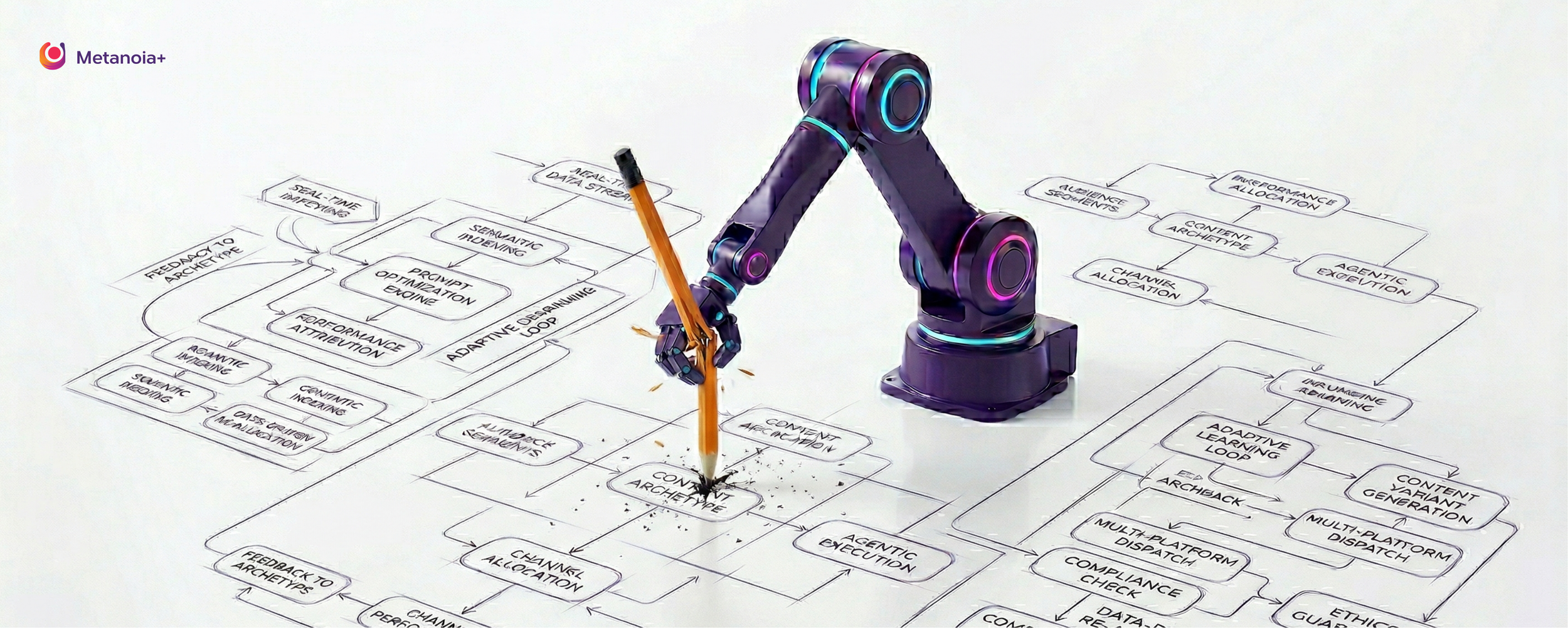
Canva is moving from a tool your team uses to create things into a platform that decides what to create, automates the campaigns around those decisions, and manages the AI agents executing the work. The Simtheory acquisition brings agentic capability specifically: AI that does not wait for a prompt but takes action autonomously on behalf of the user.
For marketing teams, the practical question is this. The tool your content team opens every morning now wants to sit where your creative director, your campaign manager, and your strategist currently sit. When a design platform starts suggesting campaign directions, or an automation layer executes a sequence without a human handoff, someone set the criteria for those decisions. If nobody on your team defined them explicitly, the tool defined them by default.
The question for your next planning review: when your production tool makes strategic recommendations, who is accountable for those calls? Is that a conversation for your creative lead, your marketing operations head, your agency, or all three? Canva is not alone in this direction. It is simply the most widely used production tool to have moved there this week. The policy conversation needs to happen before the capability makes it irrelevant.
The stack

This is about your content team.
This week, Tencent announced stricter rules on AI-generated content across WeChat, China's largest platform. The reason given: a flood of low-quality AI output was eroding user trust. Separately, a Singapore-based digital marketing director reported that content produced at scale using AI had seen a 60-80% visibility drop following Google's March 2026 core update. The mechanism is Google's information gain scoring: content now needs to add something genuinely new, not just recombine what already exists.
Two markets, two different platforms, pointing in the same direction. The production shortcut AI offered is narrowing. If your content team is still briefed primarily around volume, this is the week to ask whether the brief should shift. Producing something distinctive requires different creative inputs than producing something fast.

This is about your content roadmap.
GoDaddy this week rolled out Cloudflare's AI Crawl Control, giving website publishers the ability to decide how AI crawlers access their content, including blocking or charging bots for access. Simultaneously, SEO practitioners across SEA are documenting the emergence of a new discipline: GEO, or Generative Engine Optimisation. Traditional SEO targets Google ranking. GEO targets discoverability in AI-powered search. The two have different technical requirements, and most brand websites, according to practitioners running these audits, currently fail the AI crawl test entirely.
This is not urgent today. But it is worth raising before your next annual content planning cycle. If your content strategy was designed around Google discoverability, it does not automatically translate into AI discoverability. The audiences who find products and brands through AI search tools are navigating infrastructure that your current strategy was not built for.

This is about your market access in Southeast Asia.
TikTok and the International Chamber of Commerce this week announced Digital Commerce Labs: a joint programme launching across ten markets, with Southeast Asia, including Thailand, in scope for later this year. The programme embeds TikTok's digital commerce tools and training resources into local business communities, working through ICC's network of national chambers and business associations.
For brands operating in SEA, the direction is worth tracking. TikTok is not positioning itself only as a content distribution platform in this region. It is building itself into the commerce and business education infrastructure that local entrepreneurs rely on. As that embedding deepens, go-to-market decisions in some SEA markets will increasingly involve a question about how you operate within TikTok's ecosystem, not just how you advertise on it. Nothing to act on today. Flag this with your regional teams.
The Synthesis
The underlying shift this week: AI has moved to a new layer inside the marketing function.
For two years, the story was AI in production: faster content, cheaper creative, scaled copy. The signals this week confirm the next chapter has started. AI is moving into the decisions that sit above production: what to create, how to sequence a campaign, which content earns attention on platforms that are actively filtering AI output.
Marketing leaders who navigate this well will have an answer to a simple question: in their content operation, where exactly does the machine stop and the human begin? Most do not have a clear answer yet. The tools are moving to fill that gap. Getting ahead of it is a leadership decision, not a technology one.
The M+ Signal is published by Metanoia+.
Intelligence infrastructure for AI-accelerated economies.
