
When AI Became the Friend We Ask Before Making Decisions
Not too long ago, buying something online followed a familiar routine. Open Google. Read a few articles. Compare products. Browse Reddit. Watch a YouTube review. Eventually, a decision would emerge.
Increasingly, that journey begins somewhere else.
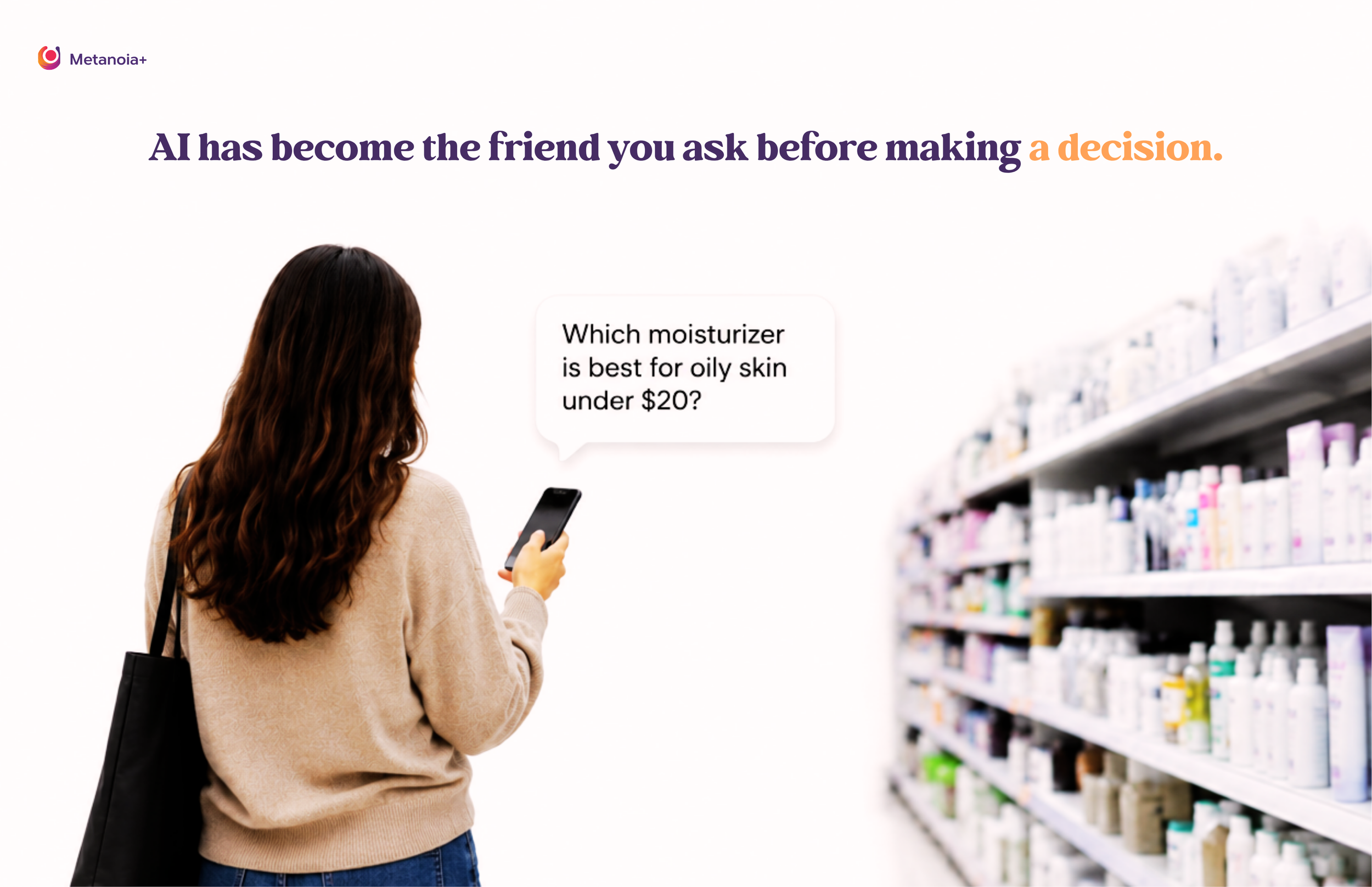
"I'm looking for a moisturiser for oily skin under $20. Which one should I buy?"
"Compare the Nothing Phone and the Pixel 9 for someone who mainly uses their phone for photography."
"Build me a beginner gym routine and recommend a protein powder."
Across more than a thousand AI-assisted consumer conversations we analysed, one pattern appeared repeatedly. People weren't asking AI to help them search. They were asking AI to help them decide.
That distinction may seem subtle, but it points to a much bigger shift. AI is moving beyond being an information retrieval tool and becoming something far more familiar: a trusted advisor that helps reduce uncertainty before a decision is made. The products varied. The questions varied. The behaviour didn't. Consumers increasingly expect AI to simplify complexity before they make a choice.

Decide the strategic direction.
One of the more interesting observations wasn't what people were buying. It was when they turned to AI.
Buying a ₹200 phone case? Not so much. Buying a ₹1.5 lakh laptop? Very different.
People increasingly ask AI to compare products, explain trade-offs and recommend options based on their personal situation before spending meaningful amounts of money.
The same behaviour appears well beyond retail. Someone choosing a hospital may ask AI to compare treatment centres before reading patient reviews. Someone purchasing health insurance may ask AI to explain exclusions, compare policies and highlight differences that would otherwise take hours to understand. Students weigh universities, professionals compare job offers, founders evaluate software vendors and families plan holidays, all by beginning with the same conversation.

Understand the consumer behaviour behind it.
Across every category we looked at, one theme surfaced repeatedly. Consumers weren't looking for more information. They were looking for less uncertainty.
That distinction matters. The internet already contains almost every answer someone could need. What it doesn't always provide is confidence. AI seems to occupy that space.
Rather than asking, "Which hospital is the best?", people ask, "Which hospital would make sense for someone with this condition?" Rather than searching for the best laptop, they ask, "I'm a designer who travels often. Which laptop should I buy?" Instead of reading dozens of insurance articles, they ask AI to compare policies in plain English. Rather than watching six YouTube videos before narrowing down a camera, they ask AI which model best fits their budget and use case before watching a single review.
The pattern repeats itself across categories. AI isn't replacing expertise. It's helping people navigate complexity before they seek expert validation. That subtle difference explains why consumers often continue to read Reddit discussions, browse reviews and watch creators after speaking to AI. The conversation hasn't ended. It has simply started somewhere new.
What emerged most consistently wasn't blind trust. People questioned recommendations, asked follow-up questions and verified information elsewhere. What they seemed to value was AI's ability to simplify complexity and reduce the effort required to reach a confident decision.

Watch the emerging signals worth following.
If AI increasingly becomes the first advisor people consult, an interesting shift begins to emerge.
Historically, first impressions were shaped by advertisements, search rankings, websites or social media. Increasingly, that first impression may come from a conversation that happens entirely inside an AI assistant.
"What do you know about this hospital?"
"Should I trust this insurance company?"
"Compare these universities."
"Tell me about this software company."
"Is this employer known for a good work culture?"
The answers consumers receive are unlikely to come from a single source. They're synthesised from websites, reviews, public discussions, news articles and countless other signals available across the internet. That doesn't reduce the importance of those sources. If anything, it makes them even more interconnected.
Perhaps the most interesting shift isn't that consumers are using AI instead of Google. It's that AI is becoming the lens through which many of those sources are first interpreted. Reviews, thought leadership, customer stories, employee experiences and a brand's broader digital footprint may increasingly shape not only how people discover organisations, but also how AI talks about them.
A different kind of advisor
The conversations we analysed weren't remarkable because people trusted AI blindly. They were remarkable because of how naturally people treated AI as someone whose opinion was worth asking.
The knowledgeable colleague who always knows which software to buy. The skincare enthusiast friends message before trying a new serum. The family member who somehow always picks the right laptop. Consumers appear to be assigning AI a similar role. Not as the final authority, but as a trusted advisor that helps make complicated decisions feel a little less complicated.
Whether the question is about buying a phone, choosing a hospital, comparing insurance policies, evaluating a future employer or deciding which agency to work with, the instinct appears to be the same.
"Before I spend my time, money or trust, let me ask AI first."
The M+ Signal is published by Metanoia+.
Intelligence infrastructure for AI-accelerated economies.
