
Your brand now has a score inside AI answers.
Who owns it?
The places your brand gets seen and measured are being rebuilt around AI, and each one is now rewarding substance over volume.
Lead story

This is about your measurement and your visibility.
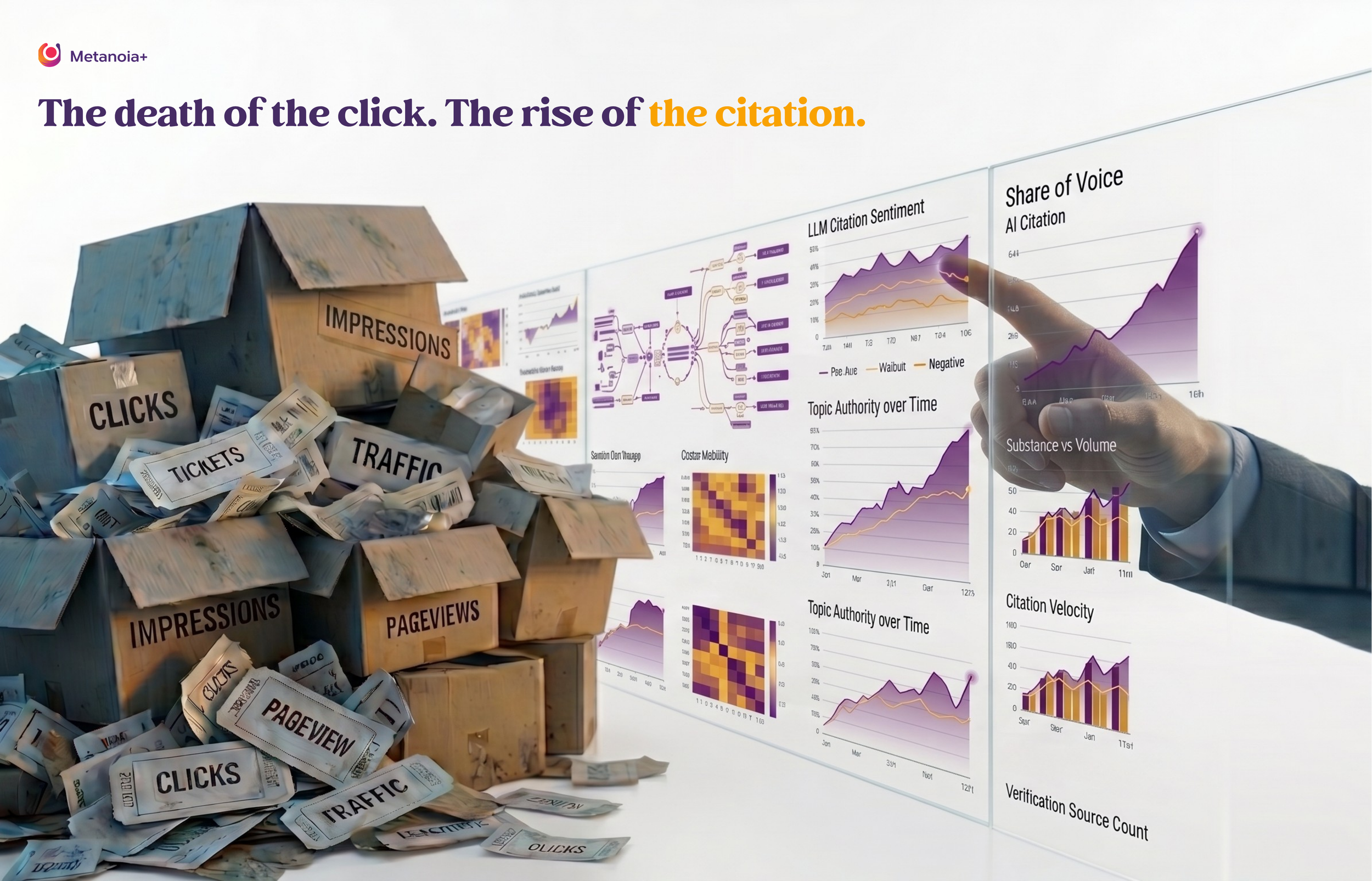
At its I/O 2026 event, Google introduced a 'brand mentions in AI responses' metric. It lets advertisers track when their brand surfaces inside Gemini, inside AI Overviews, and inside Google's agentic search answers. In plain terms, Google has started counting how often the AI talks about you when a customer asks it a question.
The number being counted is changing. For two decades the unit of marketing measurement has been the click and the impression, both of which assume a customer types a query and chooses from a list of links. That assumption is thinning. When the answer arrives as a single AI response, there is no list and often no click. There is only whether your brand made it into the answer. That share of voice inside AI results is the new visibility surface, and it now has a dashboard.
The question for your next planning cycle is concrete. Who on your team owns your brand's presence inside AI answers, and how would you know if it fell? Most reporting lines still roll up to clicks and rankings. If nobody can tell you your AI-citation share today, that is not a gap in the tool. It is a gap in who is accountable for being found at all.
What to watch: when this metric moves from Google into the platforms your team buys on every week, the pressure to report against it arrives with it.
The stack

This is about your content team.
LinkedIn said this week that it will limit the reach of generic AI 'slop' in the feed, at the same time as it rolls out more of its own AI creation tools. The two moves are not a contradiction. LinkedIn wants more content created, but it is tuning the feed to surface posts with a clear point of view and to bury filler that reads like it came off a template.
For your team this changes the brief, not the tooling. Volume was the old advantage, and it is now close to worthless on this platform. The work that travels is the work that says something specific and verifiable. That is a harder brief to write and a more useful one to give.

This is about operational risk and internal governance.
Amazon shut down an internal leaderboard that ranked employees by how much they used AI, after staff began assigning agents to needless tasks to climb it. An executive said the quiet part out loud: do not use AI just for the sake of using AI. In the same window, Publicis-owned Epsilon reported meaningful productivity gains at roughly flat headcount.
Put together, the lesson is not 'use less AI'. It is that usage is not the same as value, and that judgment about where AI belongs is now a cost worth managing. If anyone is measuring your team on adoption alone, you are measuring the wrong thing.

This is about brand safety and the value of owned content.
Two provenance stories landed this week. CNN is suing the AI answer engine Perplexity, alleging it reproduced articles almost word for word and circumvented the paywall. Separately, TikTok and Universal Music Group signed a global licensing deal that writes in AI attribution rules and the joint removal of unauthorised AI-generated music.
Nothing here forces a decision today. But the direction is clear: provenance and attribution are moving from principle into contracts and courtrooms. Original content your brand actually owns is becoming a defensible asset, not just a cost line. Worth a quiet word with whoever owns legal and whoever owns content.
The Synthesis
Four stories, one shift. The surfaces where a brand gets seen and the systems that measure that visibility are being rebuilt around AI. Google is counting citations instead of clicks. LinkedIn is ranking substance over volume. Amazon is treating undisciplined AI use as a cost. The courts are starting to price provenance. None of these is a story about producing more. Every one of them is a story about whether what you produce is clear, owned, and worth citing.
That is the thread for the next two quarters. Speed and volume were the easy wins of the last AI cycle, and they are quietly being repriced. The marketing leaders who move first will be the ones who can name who owns their visibility inside AI answers, and who can tell the difference between activity and value on their own team. Not because everything changed this week. Because enough did to make the old scorecard misleading in specific, costly places.
The M+ Signal is published by Metanoia+.
Intelligence infrastructure for AI-accelerated economies.
