
Your audience is taking the wheel.
This week's developments confirm two shifts colliding inside your 2026 plan: the AI tools your team uses every day are getting more expensive to provide, and the platforms you reach audiences on are handing more curation control to those audiences.
Lead story

This is about your budget.
Reuters this week reported that Big Tech is 'stuck in a wheel' of $600 billion-plus AI data centre capex with no signs of slowing. The IMF Managing Director told markets economies now face an 'AI or die' choice. Adding to the squeeze, Samsung foundry workers in South Korea are threatening to strike in May, which would deepen the already serious global RAM shortage that is pushing memory chip costs up across the entire tech stack.
For marketing teams, the connection is direct. Most of the AI tools your team has integrated over the past 18 to 24 months sit on top of compute infrastructure being paid for through this capex cycle. That includes content drafting, image and video generation, ad copy, transcription, sales copilots, and the various internal AI assistants now showing up inside Office, Workspace, Slack, and your CRM. Vendor pricing has not yet reflected the full cost. It will. The Adobe-style renewal conversation flagged in last week's brief is just the visible edge of a wider repricing.
The question for your next budget review is concrete. Which AI line items does your team actually depend on, and which can absorb a 20 to 30 per cent repricing without breaking the workflow? Most marketing leaders cannot answer cleanly today. If nobody pulls the AI tool inventory before the renewal cycle in the second half of the year, the renewal letters will write the answer instead.
The stack

This is about audience targeting on X.
X launched AI-powered custom feeds this week, curated by Grok. Users now select the topics they want and let Grok personalise their timeline. Coming a week after Instagram extended its 'Your Algorithm' tool to Explore, two of the social platforms your team reaches audiences on have now handed the algorithm directly to the user.
The implication is consistent across both. Organic reach planning that assumed an algorithm chooses needs revisiting on these channels. Generic interest targeting loses efficiency on platforms where users self-curate. Worth a brief conversation with your social lead about how the brief on X and Instagram changes when the audience is steering.

This is about your content team's asset sources.
Deezer reported this week that 44 per cent of songs uploaded to its platform daily are now AI-generated. The same pattern is playing out across stock audio, voiceover libraries, image marketplaces, and short-form video clip platforms. The flood is wider and deeper than most teams have priced in.
If your team sources music, voice, or visual assets from any user-generated platform for ads, social, or branded content, the share of synthetic content in your campaigns is meaningfully higher than the licensing assumption from last year covered. Worth a check with your content lead about what you trust, what you verify, and what you re-licence before the next campaign brief lands.

This is about LinkedIn as your B2B distribution channel.
LinkedIn's CEO is stepping down. For most B2B brands, LinkedIn is the primary platform for thought leadership, executive content, recruiting, and senior-decision-maker reach. Leadership transitions at distribution platforms have historically come with shifts in algorithm priorities, paid media direction, and creator tooling.
Nothing to act on today. But if posting strategy or paid mix on LinkedIn is material to your 2026 plan, flag this with whoever owns LinkedIn distribution so a direction change does not arrive as a surprise. The first signals usually show up in algorithm behaviour and creator-side tool announcements within the first quarter of new leadership.
The Synthesis
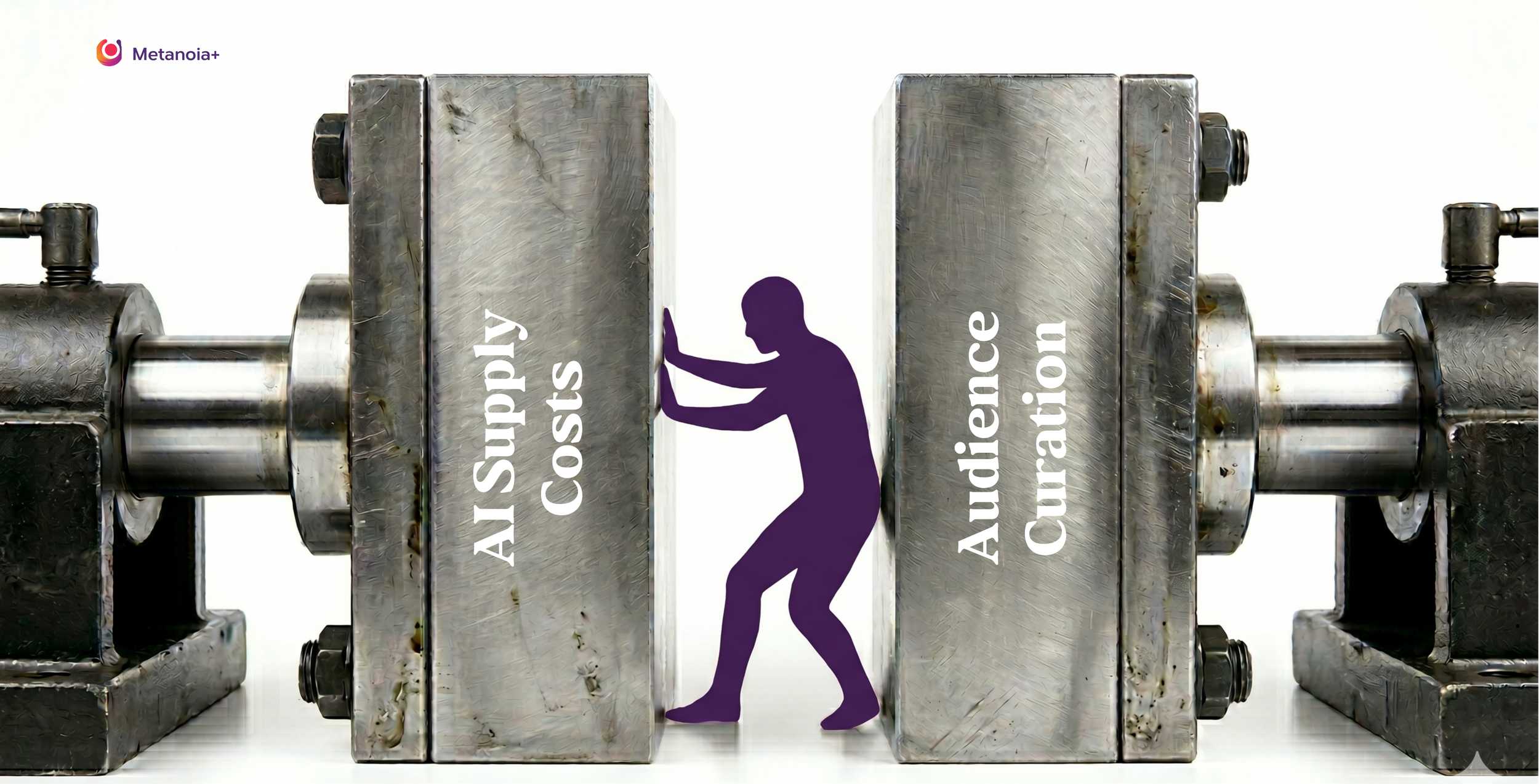
The shift this week is structural and goes in two directions at once. On the supply side, the AI tools your team uses every day are sitting on top of an infrastructure cost cycle that is climbing, not stabilising, and vendors will eventually pass that through. On the demand side, the platforms you reach audiences on are quietly handing more curation control to those audiences. Generic, high-volume, AI-produced content gets squeezed from both ends. It costs more to produce, and it reaches fewer people who want it.
The marketing leaders who plan well from here will not chase either trend in isolation. They will treat AI tooling as a portfolio that needs auditing, and audience access as something earned through specificity, not bought through volume.
The M+ Signal is published by Metanoia+.
Intelligence infrastructure for AI-accelerated economies.
